The vasocomputational model for meditation
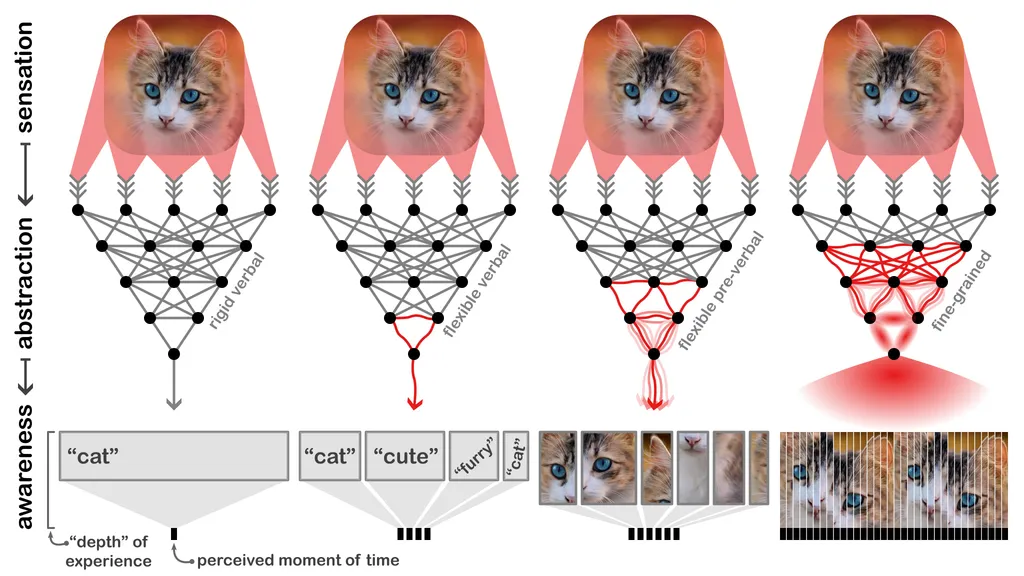
You could see meditation as mental stretching: standard intellectual skills are like training for grip strength, you get better at grasping concepts, but worse at letting them go
This is not just a metaphor, according to @johnsonmxe’s theory of vasocomputation, we freeze neural patterns (concepts) by constricting the smooth muscles of our blood vessels (grip), we are literally grasping concepts with tiny muscles, and if we don’t stretch and move enough, we lose flexibility and agility, same as with the musculoskeletal system
...
I’ve tried to illustrate the stretching/relaxation process in the diagram [above]:
- The picture of the cat at the top represents input from our sensory system
- The triangular network represents our neurovascular system filtering that input so we can fit it into conscious awareness, it’s a dynamic information filter
- As blood vessels progressively release their grip on neural patterns (left to right), awareness becomes more dynamic and gets more information from deeper (less abstract) layers of the network
- At the bottom I’ve tried to show the qualitative effects of this: experience feels deeper and richer (indicated by the height of the chunks of perception) and time appears to expand (we can only perceive time by observing change, so a more dynamic awareness creates more distinct “moments” in time)
A useful model of combining common experience, psychedelic experience, and insights from deep neural networks. In fact, it’s crazy how much the [above] diagram reminds me of the 101 explainer of how deep convolutional neural networks (CNNs) work:
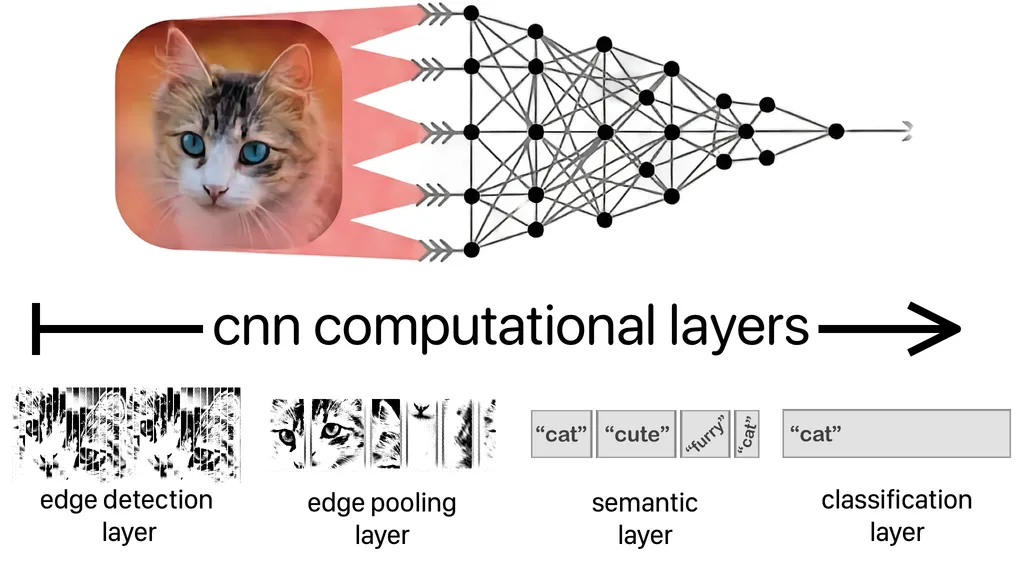
Yes, my dear reader, you noticed something -- convolutional neural networks do vasocomputation as well! Or rather, in the vasocomputation model, we “stretch” the natural neural network, our brain, to be aware of earlier stages of our information processing.
Is this finding genuine consilience? Anyway, as with any model, the goal is to create better questions and models, not to arrive at an answer.